The Resident’s Return
Memory, Loss, and Familiar Erosion
It is a peculiarity of the returning long-term resident that he notices, within the first forty-eight hours, precisely the things that the city prefers him not to see. The tourist arrives with a camera; the former resident arrives with a memory, which is considerably more damaging.
The axis of Pedro Antonio de Alarcón and the streets behind the Facultad de Derecho formed one such perimeter. The lower Albaicín and the approaches to Gran Vía formed another. Both were already familiar enough to outsiders to risk being mistaken, in retrospect, for the whole story. They were not.
Around the three large hospitals — El Clínico, Ruiz de Alda and Traumatología — the Barrio de los Doctores sustained a dense local economy of bars in a register brisker and less ornamented than the centre’s. The clientele was hospital staff, medical students, and the families of patients who had travelled in from villages across the province for an appointment or a longer stay. The contrast between rural arrival and urban transaction produced an atmosphere unlike any other in the city: prices adjusted for people with no margin for surprises, an instinctive courtesy at the bar, and the regular small surprise of recognising someone. A taxi driver who had brought a parcel from a relative. A neighbour from a town two valleys over delivering bread and clean clothes to a nephew enrolled in his first year at the university. These encounters were not picturesque. They were the unremarkable infrastructure by which a provincial capital remained continuous with its hinterland.
Around the Facultad de Ciencias, the ascending stretches of Camino de Ronda produced another perimeter, less concentrated but more continuous. The cafeterias and small bars there accommodated the rhythm of science undergraduates: earlier mornings, shorter lunches, longer laboratory afternoons. The student flats above and around them sustained a generational density which the local businesses recognised. Students were not a marginal demographic to be tolerated but the principal category of customer, and the prices reflected the calculation.
The neighbourhood of El Zaidín, larger and more internally varied than any of the above, sustained at least two distinct registers depending on proximity to the centre and to the main access roads. Around La Hípica, the bars and cafeterias resembled in tone the perimeters closer to the university — slightly cheaper, somewhat less student-saturated, but recognisable. Further south, around Santa Adela, the register changed entirely. The clientele was no longer students but workers in low-qualification trades and the pensioners who lived in the housing blocks then standing. Several of those blocks have since been described as precarious, and a number have been demolished and replaced by structures more than twice as tall, built in the apparent hurry of recent peripheral construction and carrying the anonymous aspect that such hurry tends to leave behind. The football stadium nearby manages the same architectural register: relatively new, cheap, industrially produced. The bars and outdoor terraces between Avenida de Dílar and the stadium served their customers on terms which assumed, correctly, that those customers were not going anywhere else. La Chana, further out and socially distinct from all of the above, sustained a traditional repertoire of neighbourhood bars and outdoor terraces whose clientele was predominantly local and whose prices reflected that fact.
Two of these perimeters — the Barrio de los Doctores and the streets around Santa Adela — form, in retrospect, the baseline of what one might cautiously call habitable urban space. They were not the most charming. They were not the most photographed. But they were the places where the use was frequent enough, the prices recognisable enough, and the welcome reliable enough that visiting them produced, almost involuntarily, the impression of belonging. That impression is the thing the volume is principally about, because it is the thing that has been most thoroughly dismantled. The point of this enumeration, then, is not to produce a nostalgic atlas. It is to record that the infrastructure of affordable sociability was distributed across the municipality, not concentrated in the half-dozen streets that subsequent decades have selected for conversion. A student, a hospital orderly, a junior lecturer, a retired mason and a shift worker could each find, within a short walk of where they lived or worked, a place that served them on terms they recognised. The disappearance of some of these perimeters and the transformation of others is not a uniform phenomenon, and the chapters that follow try to keep the differences in view.
The evening I am thinking of ended earlier than most. The bar normally closed at around one in the morning; on this occasion it closed shortly before eleven, and it did so by the simple expedient of admitting the window-side party, waiting for the other customers to finish and leave, and then locking up. The decision, as I understood it at the time and have had no reason to revise since, rested on a single empirical observation: the group was drinking beer at a rate which, multiplied by the minimum obligatory plate per round, would exhaust the kitchen’s entire stock of seafood and fish before midnight. Closing early was not a gesture of hospitality. It was an exercise in inventory management, conducted with the precision of someone who had done the arithmetic in his head while uncorking the eighth bottle.
Not every proprietor in the category merited the same defence. One of the nearest establishments of comparable ambition was a beer house whose tapas consisted of salted nuts and, on generous days, a slice of dry sausage. Another, smaller still and even less ventilated, served almost exclusively a snail broth ladled into short glasses, which the customer was expected to consume as if it were a drink — an arrangement which, on a sufficiently cold evening, had its defenders. The contrast clarifies the point. This proprietor did merit the defence, and the distinction is worth preserving, because it is the distinction on which a significant part of the argument will eventually rest.
There was, moreover, the matter of what followed the closing of the door. Once the seafood-bound party had been admitted and the bar locked behind them, the proprietor — who was, as established, also the cook, the waiter and, when required, the window — would set down his apron, pour himself a glass, and join the group as one more drinker, contributing his views on the subjects that mattered with the same unhurried directness he applied to seafood. One such evening was, by the accepted local arithmetic, sufficient to count thereafter as kinship. A certain amount of what I remember as conviviality was, in retrospect, tolerance for conditions that had not yet acquired the dignity of being called substandard. This is the point at which the argument has to become careful, because it is exactly here that nostalgia does its damage: by converting the absence of a better alternative into a positive quality of the thing remembered.
The decline has since been documented at scale, though not without friction. Between 2010 and 2024 the number of beverage establishments in Spain fell by just over nineteen per cent, from 202,720 to 163,890 (see Table 10.1); the loss was distributed unevenly across the autonomous communities (Table 10.2), and the statistical apparatus through which it can be observed was not designed to see the kind of establishment this volume is chiefly concerned with (see A note on measurement). A partial inventory of the Granada closures that reached the local press between 2017 and 2024 is included in Table 10.3. The loss is neither recent nor local. What is local is what the loss has replaced, and what it has not.
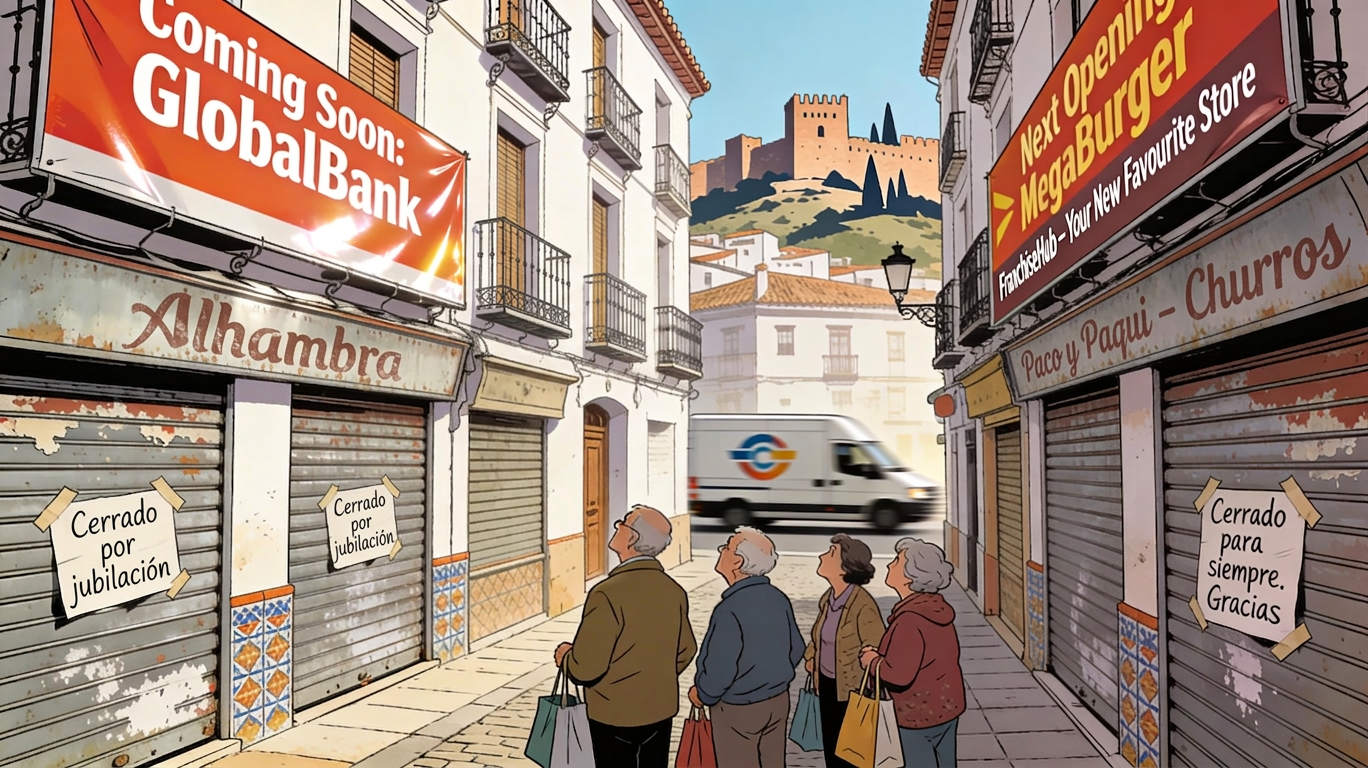
Plate III. Commercial transition, central Granada, present day. Three premises simultaneously available: two proprietors have retired; one has closed permanently, having had the courtesy to say so. The incoming tenants — a global financial institution and a burger franchise that describes itself as the customer’s new favourite before the customer has been consulted — have secured prominent signage above the shuttered ironwork. The Alhambra occupies the background in its customary capacity. A delivery vehicle passes without stopping, which is the appropriate response. Four residents, carrying bags that suggest they have managed to find food somewhere, assess the situation. Their expressions are not recorded.